Pipeline Parallelism in Inference
In the previous post, Inference Engine, we built an async inference engine. Adding pipeline parallelism (PP) complicates the control flow, especially around send/recv ordering and shutdown. This post walks through the problem and two ordering designs, then lands on a simple loop structure.
1) The Naive Pipeline
Each rank receives tensors, runs the model, and sends the output to the next rank.
class Inferencer:
    def infer(self):
        ctx = self._get_ctx()
        output = self._model.forward(ctx)
        self._send_to_next_rank(output, ctx)
The flow is clean but produces crossing dependencies:
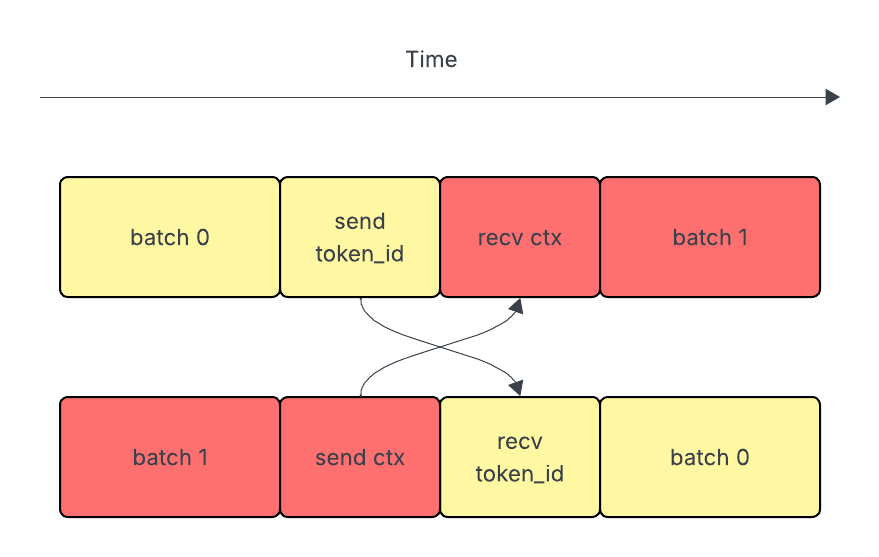
If send/recv are blocking (e.g., torch.distributed.send_obj_list for CPU metadata), the arrows cross and deadlock. GPU tensors can live on separate CUDA streams, but CPU metadata cannot.
2) Fixing the Ordering
The fix is to flip the send/recv order on either the first or last PP rank.
Option A: First-Rank Special-Case (Preferred)
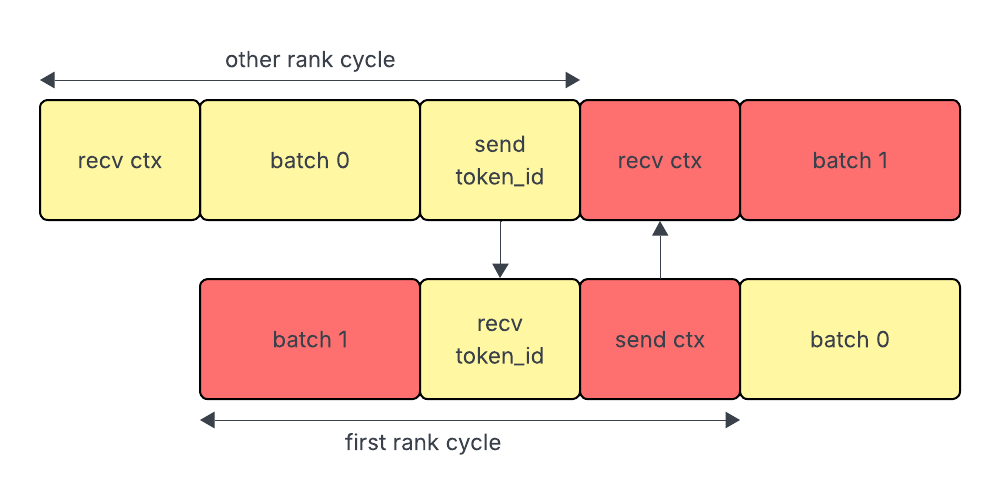
Only the first rank differs; all other ranks stay naive.
# first rank cycle
def infer(self, batch, should_recv_out):
    ctx = self._prepare_ctx(batch)
    output = self._model.forward(ctx)
    if should_recv_out:
        token_id = self._recv_token_id()
    self._send_ctx(output, ctx)
    if should_recv_out:
        return token_id
should_recv_out says whether this cycle expects a return token from the last rank. The scheduler already tracks batch movement, so it can provide this flag. Complexity is isolated to the first rank.
Option B: Last-Rank Special-Case (Awkward)
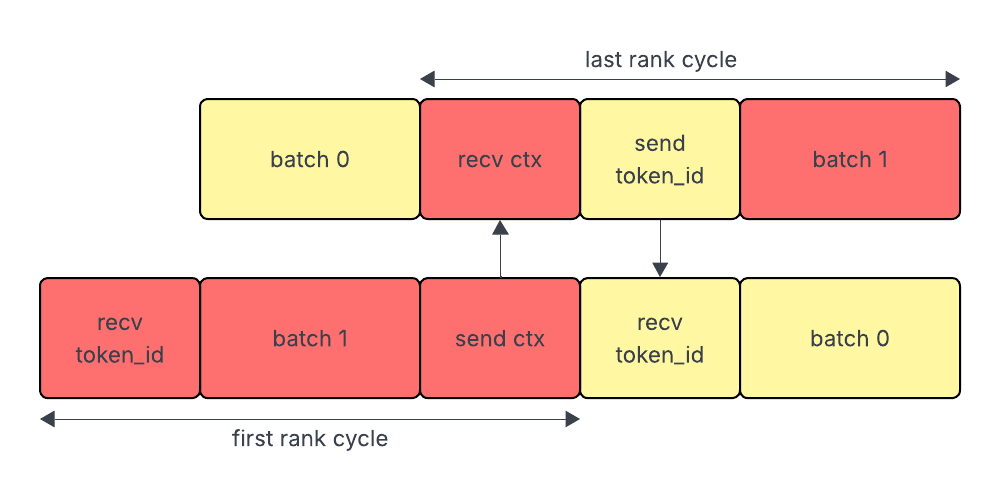
The first rank stays naive; the last rank breaks symmetry and becomes stateful.
def infer(self):
    ctx = self._get_ctx()
    if self._last_token_id:
        self._send_token_id(self._last_token_id)
    token_id = self._model.forward(ctx)
    self._last_token_id = token_id
Problems:
- Introduces hidden state (_last_token_id) that complicates testing.
- Breaks when no new batches arrive; the last token never sends because the loop blocks on _get_ctx().
- Requires extra scheduling logic on non-first ranks, making the code ugly fast.
Because Option A keeps all stateful logic on the first rank (owned by the scheduler), it is the better default.
3) Loops on Each Rank
With Option A, the loops look like this:
class Engine:
    def first_rank_loop(self):
        while True:
            next_batch, requests_to_receive = self._scheduler.schedule()
            token_ids = self._inferencer.infer(next_batch, requests_to_receive)
            completed = self._output_processor.process(requests_to_receive, token_ids)
            self._scheduler.cleanup_requests(completed)

class Worker:
    def other_rank_loop(self):
        while True:
            self._inferencer.infer([])
All non-first ranks stay simple; the scheduler drives statefulness on the first rank.
4) Shutdown Considerations
Simple loop termination via torch.multiprocessing.Event is not enough; loops block waiting for get_ctx(). Two approaches:
- Shutdown ctx sentinel: Send a special ctx through the pipeline to signal exit. This makes
inferreturn a shutdown signal, which can be awkward. - Queue batches instead of pull: Pass
next_batchviamp.Queue; each rank callsprepare_ctxinstead ofget_ctx. This simplifiesinferbut does extra per-rank prep. It also only works withtorch.multiprocessing, not multi-nodetorch.distributed.
Given multi-node PP needs torch.distributed, the first-rank special-case with scheduler-driven flags remains the pragmatic choice.
5) Takeaways
- Deadlock arises when CPU metadata send/recv are blocking with naive ordering.
- Flip ordering on a single rank to break the dependency; prefer doing it on the first rank.
- Keep all scheduling and state on the first rank; keep other ranks stateless and loop-simple.
- Plan shutdown early; avoid designs that force hidden state on non-first ranks.